
Views: 0 Author: Site Editor Publish Time: 2026-09-24 Origin: Site
When customers choose austenitic stainless steel, three grades often come up: 1.4301, 1.4404, and 1.4541, commonly corresponding to 304, 316L, and 321.
They may look very similar, and many of their processing characteristics overlap, but their performance can be quite different once they are put into service.
Some are better suited to general environments, some offer better resistance to chlorides, and others are more suitable for welded parts exposed to elevated temperatures.
So the key question is not which grade is “better,” but which one matches the actual working conditions.
1.4301 corresponds to AISI 304 and is one of the most widely used austenitic stainless steels.
It is mainly alloyed with chromium and nickel and offers a good balance of corrosion resistance, formability, and weldability.
Typical applications include:
Precision stamped parts
Kitchen equipment
Food processing machinery
Household appliance components
General industrial parts
If the product is mainly used indoors, in dry conditions, or in an environment without strong corrosive media, 1.4301 is often sufficient.
It is also widely available, easy to process, and relatively cost-effective.
Its main limitation is chloride exposure.
In coastal atmospheres or applications involving salt, prolonged contact with sweat, or chloride-containing cleaning agents, the risk of pitting corrosion increases. In these cases, 1.4404 may be a better option.
1.4404 corresponds to AISI 316L.
Compared with 304, one of its main differences is the addition of about 2%–2.5% molybdenum (Mo), together with a lower carbon content.
Molybdenum improves resistance to chloride-induced pitting and crevice corrosion, while the lower carbon level helps reduce the risk of intergranular corrosion after welding.
For this reason, 316L is commonly used in:
Food processing equipment
Pharmaceutical equipment
Chemical processing equipment
Coastal environments
Salt- or chloride-containing media
Welded structures requiring higher corrosion resistance
If a component will be exposed to salt, chlorides, or corrosive media for long periods, 1.4404 is usually worth considering first.
That said, 316L is not completely immune to corrosion in every seawater or high-chloride environment. Temperature, chloride concentration, surface condition, and service conditions still matter.
1.4541 corresponds to AISI 321.
Its main feature is the addition of titanium (Ti).
Titanium preferentially combines with carbon, helping reduce chromium carbide precipitation at grain boundaries during welding or elevated-temperature exposure. This lowers the risk of sensitization and intergranular corrosion.
For this reason, 321 is often used in:
Exhaust systems
High-temperature piping
Heat exchange equipment
Industrial furnace components
Welded parts exposed to elevated temperatures
Compared with standard 304, 321 is often a better choice for applications involving both welding and prolonged exposure to higher temperatures.
However, 321 was not developed primarily to improve chloride resistance.
At room temperature, its pitting resistance is generally closer to 304 than to 316L.
So if the main concern is seawater, salt spray, or chloride-containing media, 321 should not automatically be used in place of 316L.
A practical way to compare the three grades is to start with the service environment:
Grade | Main Characteristics | Typical Applications |
1.4301 / 304 | Good general performance, good formability, cost-effective | Indoor, dry, mildly corrosive environments, general industry, precision stamping |
1.4404 / 316L | Better resistance to chlorides and crevice corrosion | Food, pharmaceutical, chemical, coastal, salt- and chloride-containing environments |
1.4541 / 321 | Better stability after welding and at elevated temperatures | Exhaust systems, heat exchangers, industrial furnaces, high-temperature welded structures |
As a simple guideline:
General environment: 1.4301
Salt, chlorides, or corrosive media: 1.4404
Welding plus elevated-temperature service: 1.4541
If a component requires welding, operates in a corrosive environment, and is also exposed to high temperatures, the final material choice should be based on the actual medium, service temperature, processing method, and required service life.
DSM can supply:
1.4301 Stainless Steel Strip 1.4404 Stainless Steel Strip 1.4541 Stainless Steel Strip | 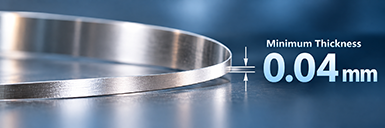 |
Our precision stainless steel strip can be supplied with a minimum thickness of:
Minimum Thickness: 0.04 mm
We can also customize according to customer requirements, including:
Thickness & Width
Hardness / Temper
Surface Finish
Slit Edge / Deburred Edge / Round Edge
Thickness Tolerance
Surface Roughness
For precision stainless steel strip, the grade is only one part of the specification.
Thickness tolerance, hardness, surface condition, roughness, and edge quality can also have a direct impact on stamping, forming, welding, and final assembly.
If you are sourcing 1.4301, 1.4404, or 1.4541 precision stainless steel strip, you can send us your required thickness, width, hardness, surface finish, quantity, and final application.


