
Views: 0 Author: Site Editor Publish Time: 2026-10-08 Origin: Site
When purchasing stainless steel, customers often ask:
“304 stainless steel is more expensive. Can we replace it with 430?”
AISI 430 is a ferritic stainless steel primarily alloyed with chromium, while AISI 304 is an austenitic stainless steel containing chromium and nickel. The two grades differ significantly in corrosion resistance, formability, weldability, and cost.
Whether 430 can replace 304 depends on the actual application requirements, not just the price.
Property | ||
Stainless Steel Type | Ferritic | Austenitic |
Main Alloying Elements | Cr | Cr-Ni |
Magnetism | Generally magnetic | Usually non-magnetic or slightly magnetic in the annealed condition |
Corrosion Resistance | Suitable for mild environments | Generally better |
Formability | Suitable for certain stamping applications | Generally better for complex forming |
Weldability | Depends on thickness and welding process | Generally better |
Cost | Usually lower | Usually higher |
430 is not simply a lower-grade version of 304. These materials are designed for different applications and performance requirements.
For indoor equipment, household appliance components, and decorative parts that are not continuously exposed to salt, acidic substances, or highly corrosive environments, 430 may provide sufficient corrosion resistance.
If the material meets the application requirements, choosing 430 can help reduce raw material costs.
430 stainless steel is generally magnetic, while annealed 304 is usually non-magnetic or only slightly magnetic. However, 304 may develop magnetic properties after cold working.
For certain household appliances, electronic equipment, and industrial components requiring magnetic response, 430 may be a more suitable choice.
For mass-produced stamped parts, appliance components, and general industrial products, raw material prices can significantly affect overall production costs.
If 430 meets the required corrosion resistance, formability, surface quality, and product standards, replacing 304 with 430 may offer cost-saving opportunities.
430 generally has lower overall corrosion resistance than 304. In environments with high salt concentrations, prolonged moisture exposure, or chlorides, using 430 may increase the risk of localized corrosion.
For more demanding environments, stainless steel grades such as 316 may need to be considered.
304 generally offers better ductility and is well suited for complex drawing and multi-stage forming processes.
Although 430 can also be stamped, its forming behavior differs from that of 304. Direct substitution may lead to cracking, wrinkling, or changes in springback.
Therefore, actual tooling trials are recommended before switching materials.
430 can be welded, but its welding characteristics differ from those of 304.
For products requiring extensive welding, high weld quality, or reliable corrosion resistance after welding, the welding process and final product performance should be verified before substitution.
If customer drawings, product standards, or project certifications explicitly require AISI 304, suppliers should not independently substitute it with 430.
Any material substitution should undergo technical evaluation and receive approval from the customer or project owner.
Not necessarily.
Purchasing costs include more than just the raw material price. Processing costs, production yield, tooling adjustments, surface treatment, and service life should also be considered.
If switching to 430 results in forming defects, increased corrosion risks, or additional certification expenses, the total cost may actually increase.
The key is to compare Total Cost, not just Price per Ton.
Before replacing 304 with 430, consider the following questions:
Will the product be used indoors or outdoors? Will it be exposed to salt or chemicals?
Does the application require deep drawing, complex stamping, or welding?
Are magnetic properties required?
Do the drawings explicitly specify AISI 304?
Are there salt spray testing, hardness, or surface finish requirements?
What are the annual purchasing volume and cost targets?
Neither 430 nor 304 is universally better. The right choice depends on the application.
430 may be a suitable alternative for mild environments, magnetic applications, and cost-sensitive products. However, direct substitution is not recommended without proper validation for highly corrosive environments, complex forming, demanding welding applications, or projects that specifically require 304.
Material selection should follow this approach:
Application Environment → Processing Requirements → Material Performance → Total Cost
DSM supplies AISI 430 stainless steel coils, sheets, and strips, as well as 300 series precision stainless steel strips.
We offer customized solutions for different thicknesses, widths, hardness levels, 2B/BA surface finishes, and precision slitting requirements. | 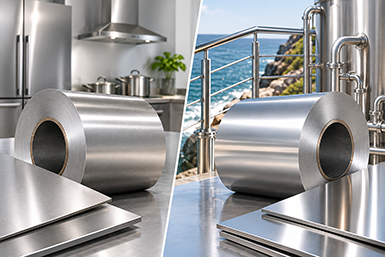 |
If you are considering replacing 304 with 430, please share your application, dimensions, and technical requirements. Our team can help you evaluate a suitable material solution.
Website: www.dsmsteel.com
Email: info@dsmsteel.com


