
Views: 0 Author: Site Editor Publish Time: 2026-11-12 Origin: Site
Many inquiries begin with a simple question: “How much does stainless steel strip cost per tonne?” That question alone is not enough for an accurate quotation. Even for the same grade, differences in delivery condition, tolerances, and order quantity can lead to substantial price differences.
The more complete your specifications, the faster and more accurate the quotation—and the less room there is for disagreement after delivery. Before sending an inquiry, work through these seven items.
Start with the basics. Common austenitic grades such as 304 and 316L, martensitic grades such as 410 (12Cr13) and 420 (20Cr13), and ferritic 430-series grades serve different applications.
Include the applicable standard, such as GB/T 4237 or ASTM A240, when specifying the grade. Chemical composition limits can differ between standards, even for nominally equivalent grades.
If you are unsure of the grade, send the material details from your previous supplier or a photograph of the material designation on the drawing. These can provide a basis for confirming the specification.
The application and subsequent processing directly affect material recommendations.
Deep-drawn parts need suitable ductility and controlled planar anisotropy to reduce splitting and earing. Stainless steel brake discs generally require martensitic grades followed by heat treatment. For decorative parts, surface finish is often the first consideration.
A coil suitable for making shims may not be suitable for deep-drawn components.
Two other requirements are easy to overlook. Spring components and spring washers may require hard-temper or quenched-and-tempered material; annealed stock may need further hardening before it can meet the intended performance requirements. For welded components, the weldability of high-carbon martensitic grades also needs careful consideration.
Clear application details give the supplier a basis for recommending material that is better suited to the job—and potentially less expensive.
The same grade may be supplied in the soft annealed condition or a cold-worked temper such as 1/4H, 1/2H, 3/4H, or H. Martensitic grades may also be supplied in the quenched-and-tempered condition.
These conditions differ in strength, ductility, and price.
If hardness is important, specify the target range and test method. Descriptions such as “a little harder” leave too much room for interpretation.
Provide the thickness, width—including the finished slit width where applicable—length or coil diameters, and the relevant tolerances. For example, 4.2 ± 0.05 mm and 4.2 ± 0.15 mm can involve different processing costs. Tighter tolerances generally require more control during rolling, slitting, and inspection, which affects the quotation. Our previous article covered camber, cross bow, and coil set. If these affect blanking or stamping, include the permissible limits in the inquiry. For coil orders, also specify requirements for winding tightness, telescoping, and wrap alignment. Loose winding and telescoping can cause feeding problems during uncoiling. | 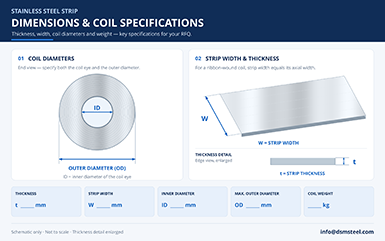 |
Specify whether you need full-width coils or slit coils, mill edges or trimmed edges, a 508 mm or 610 mm coil inner diameter, and any maximum coil weight.
Your lifting and uncoiling equipment determines these requirements.
For cut-to-length sheets, provide the required length, width, and cutting tolerances.
If these details are left unspecified, the supplier may use its standard delivery configuration.
An initial trial order of 3 tonnes and an annual requirement of 50 tonnes call for different quotation arrangements.
Quantity affects minimum order requirements, production scheduling, and pricing. If annual demand is stable, you can discuss a framework agreement with agreed pricing and delivery terms for a defined period.
For trial orders, first confirm whether the supplier accepts small batches.
It is also worth asking whether deliveries can be split and whether the supplier can hold safety stock on your behalf. Both can make a considerable difference to working capital requirements.
Include the applicable standard, the information required in the material test certificate (MTC), and whether chemical composition or mechanical properties need independent retesting.
Also specify the required surface finish, such as 2B, BA, or No. 4; any salt spray testing requirements; and the acceptance criteria for strip shape and edges.
A few clear lines attached to the inquiry can prevent lengthy discussions later.
Agree on retesting costs and how the results will be handled. For example, who pays the freight and testing charges if the material fails a retest? These points are easier to settle before an order is placed.
Acceptance requirements discussed early are part of the commercial agreement. Requirements raised only after delivery can become a source of dispute.
In practice, three items are particularly easy to overlook: tolerances, delivery condition, and acceptance requirements. Without tolerances, each side may rely on its usual assumptions. Without a specified condition, the material may arrive with the wrong hardness. Without agreed acceptance criteria, disagreements begin after delivery. Clarifying these three items can prevent many avoidable problems.
The checklist does not have to be completed all at once. Grade, dimensions, delivery condition, and quantity are enough to start the quotation process; the remaining details can be confirmed before the order is finalized.
Complete specifications can do more to control purchasing costs than repeated price comparisons alone. They help prevent rework and production stoppages, where the larger costs often arise.
DSM supplies stainless steel strip and provides slitting, shearing, laser cutting, and heat treatment services. Send us the completed checklist together with your drawings. If any parameters are missing, we can work through them with you.
Contact: info@dsmsteel.com


