
Views: 0 Author: Site Editor Publish Time: 2026-09-17 Origin: Site
When purchasing stainless steel, “cold-rolled or hot-rolled?” sounds like a basic question. But once it comes to an actual project, the answer is rarely that simple.
Some customers care most about the surface. They want it flat, clean, smooth, and free from obvious oxide scale. Others focus more on thickness tolerance and stamping accuracy. In some applications, appearance is not the priority at all; thickness, strength, processing capability, and total cost matter more.
So cold-rolled and hot-rolled stainless steel are not really about which one is “better.” The right choice depends on how the final product will be used, how it will be processed, and which properties really need to be controlled.
Simply put, hot rolling means rolling stainless steel at a high temperature.
At this temperature, the material has better plasticity and lower rolling resistance, which makes hot rolling more suitable for producing thicker coils, sheets, and plates.
After hot rolling, an oxide layer normally forms on the surface. The material is then typically annealed and pickled. The commonly seen No.1 finish is a typical hot-rolled stainless steel surface.
Hot-rolled stainless steel has several clear characteristics:
Suitable for a wider thickness range, especially medium and heavy gauges
High production efficiency
More cost-effective for thicker plates and larger sizes
Surface roughness and flatness are generally not as good as cold-rolled material
Dimensional tolerances, especially on thinner gauges, are usually less precise than cold rolling
For this reason, hot-rolled stainless steel is commonly used where decorative appearance and high dimensional precision are not the main concern, but thickness, strength, and structural performance are important.
Typical applications include chemical equipment, tanks, pressure vessels, structural components, industrial machinery, flanges, brackets, thick plate parts, and products that will undergo further machining.
In these applications, whether the surface is bright or highly polished is usually not the key issue. Material performance, thickness, and cost are often more important.
Cold rolling is carried out on hot-rolled material through further rolling and finishing processes.
Compared with hot rolling, cold rolling allows better control of thickness, flatness, and surface quality. It is therefore more suitable for thinner gauges and high-precision applications.
Common finishes such as 2B, BA, 2R, and 2BB are generally associated with cold-rolled stainless steel.
The main advantage of cold-rolled material can be summed up in one word: precision.
More accurate thickness control
Better flatness and shape
Finer and cleaner surface quality
Ability to produce thinner gauges
Better suited for slitting, stamping, bending, forming, and precision processing
When it comes to precision stainless steel strip, customers often care about much more than whether the grade is “304, 301, or 420.”
They start asking questions such as:
What is the thickness tolerance?
How stable is the thickness within one coil?
Is the hardness uniform?
How flat is the strip?
Are there scratches on the surface?
How much burr is there on the edge?
What surface roughness, or Ra, can be achieved?
These details directly affect feeding, stamping, forming, and consistency of the finished product.
From a production point of view, the most obvious difference is the rolling temperature.
But from a purchasing and application point of view, the following factors matter more.
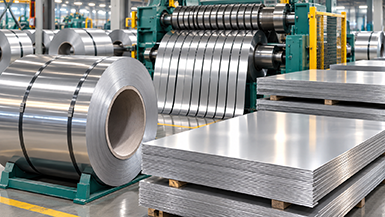 | Thickness RangeHot-rolled stainless steel is generally more suitable for thicker gauges. If the application requires medium or heavy plate, hot-rolled material is usually the more practical option. Cold-rolled stainless steel, on the other hand, is better suited to thinner gauges, especially precision strip. For applications such as blades, springs, precision stampings, and electronic parts, the thickness may be only a few tenths of a millimeter, or even thinner. In these cases, cold rolling offers much better control over thickness and flatness. |
After annealing and pickling, hot-rolled stainless steel usually has a relatively uniform gray-white or matte appearance, but the surface is not as fine as cold-rolled material.
Cold-rolled stainless steel offers a wider range of surface finishes, including:
2B, BA, 2R, 2BB, Polished, Ground, and others.
If the product has requirements for appearance, friction, surface roughness, or subsequent polishing, cold-rolled material is often the better choice.
This is especially important for knives, medical instruments, electronic parts, and precision stampings, where the surface condition may directly affect later processing quality.
For many projects, this is one of the most important differences.
In general structural applications, a small thickness variation may not be a major issue.
But in continuous stamping, precision forming, springs, or blade applications, even a small difference in thickness can affect die clearance, forming dimensions, and product consistency.
That is why applications with tighter tolerance requirements usually favor cold-rolled material.
For precision stainless steel strip, customers often specify requirements such as:
Thickness tolerance
Thickness variation across the strip
Thickness consistency throughout the coil
Edge dimensions
Width tolerance
These are not minor details. They are key parameters in precision manufacturing.
Cold-rolled stainless steel usually achieves better flatness because it undergoes more rolling and finishing steps.
Flatness is extremely important for stamping, laser cutting, cut-to-length processing, and automatic feeding.
If the strip has excessive wave, edge wave, or center buckle, processing efficiency can drop significantly.
For highly automated production lines, flatness is often one of the most closely controlled parameters.
Many customers have a simple impression:
Hot-rolled is cheaper. Cold-rolled is more expensive.
There is some truth to that, but it does not tell the whole story.
For the same heavy gauge, hot-rolled material is usually more cost-effective.
However, if the final product still requires substantial surface finishing, precision grinding, flattening, or further reduction in thickness, choosing the right cold-rolled condition from the beginning may actually reduce the total processing cost.
The purchase price is only one part of the cost.
What really matters is the total cost from raw material to finished product.
The main strengths of cold-rolled stainless steel are precision, surface quality, and process stability.
It is particularly suitable for the following applications.
Examples include electronic parts, hardware components, connectors, and small structural parts.
These applications are sensitive to thickness tolerance and flatness. The more stable the material is, the smaller the dimensional variation during stamping.
Applications include razor blades, food blades, industrial blades, utility blades, medical blades, scissors, and other cutting tools.
Besides the steel grade itself, customers often need to control hardness, thickness, flatness, surface roughness, edge condition, and stability after heat treatment.
Examples include constant-force springs, spring strips, and elastic components.
These applications usually have strict requirements for hardness, tensile strength, thickness, and spring-back performance.
These parts are often made from thin material and require good dimensional stability and surface quality.
Some automotive components and industrial precision parts also use cold-rolled stainless steel, especially when stamping, forming, or surface quality is important.
If the material is relatively thick and the product does not require a highly refined surface or very tight dimensional tolerances, hot-rolled stainless steel is often the more suitable choice.
Typical applications include:
Industrial structural components
Chemical processing equipment
Storage tanks
Pressure vessels
Large mechanical parts
Thick plate cut parts
Components requiring turning, milling, or other machining processes
In these projects, the key concerns are usually chemical composition, mechanical properties, thickness, and machinability.
Whether the surface is 2B or BA is usually not the main issue.
In real discussions with customers, we often see the same situation.
A customer may start by asking:
“Can you supply this grade in cold-rolled condition?”
But after further discussion, it becomes clear that “cold-rolled” itself is not the real requirement.
The actual concern may be:
The material must not deform after stamping
The surface must be free from scratches
Ra must be controlled
The coil must feed smoothly
Burr after slitting must be limited
Hardness must stay within a specific range
The final product needs hardening, grinding, or polishing
In these cases, simply saying “Yes, we can supply cold-rolled material” is not enough.
Even within the same cold-rolled stainless steel grade, different hardness levels, surfaces, edge conditions, flatness, and tolerances can produce very different results in actual use.
That is why we usually prefer to understand the customer's final product and processing method first, and then determine the most suitable material solution.
If a customer is not sure whether cold-rolled or hot-rolled stainless steel is more suitable, we normally start by confirming several basic parameters.
· Material grade
301, 304, 430, 410, 420J1, 420J2, 1.4034, 1.4116, etc.
· Final application
Is the material used for blades, springs, stampings, or structural components?
· Thickness and width
Different dimensions may require completely different production routes.
· Hardness or mechanical properties
Annealed, hard, half-hard, or whether further heat treatment is required.
· Surface requirement
2B, BA, 2R, Polished, Ground, or a specific Ra requirement.
· Edge condition
Slit edge, deburred edge, or round edge.
· Subsequent processing
Stamping, bending, laser cutting, grinding, hardening, or direct assembly.
Once these conditions are clear, deciding on the material condition becomes much easier than simply comparing cold rolling with hot rolling.
For many industrial customers, stainless steel is only the first step in the manufacturing process.
If the material is not suitable, problems can appear later:
Unstable stamping dimensions
Faster die wear
Surface scratches
Distortion after heat treatment
Excessive grinding allowance
Lower production yield
Inconsistent performance within the same batch
That is why a proper stainless steel supply solution should include more than just grade and price.
Material condition, dimensional tolerance, surface finish, hardness, flatness, edge treatment, and downstream processing all need to be considered together.
As a stainless steel manufacturer and supplier, our goal is not simply to tell customers which material to buy.
We prefer to start from the final application, understand how the material will be processed, and help determine a more suitable material and processing solution.
If you are choosing between cold-rolled and hot-rolled stainless steel, or if you have questions about steel grade, hardness, surface finish, thickness tolerance, edge condition, or downstream processing, feel free to send us your drawings, specifications, or information about the final product.
Based on the actual application, we can help you identify a more suitable stainless steel material and processing solution.


